Will 'Palestine 36' showcase the true history of the Arab revolt? - Opinion Piece
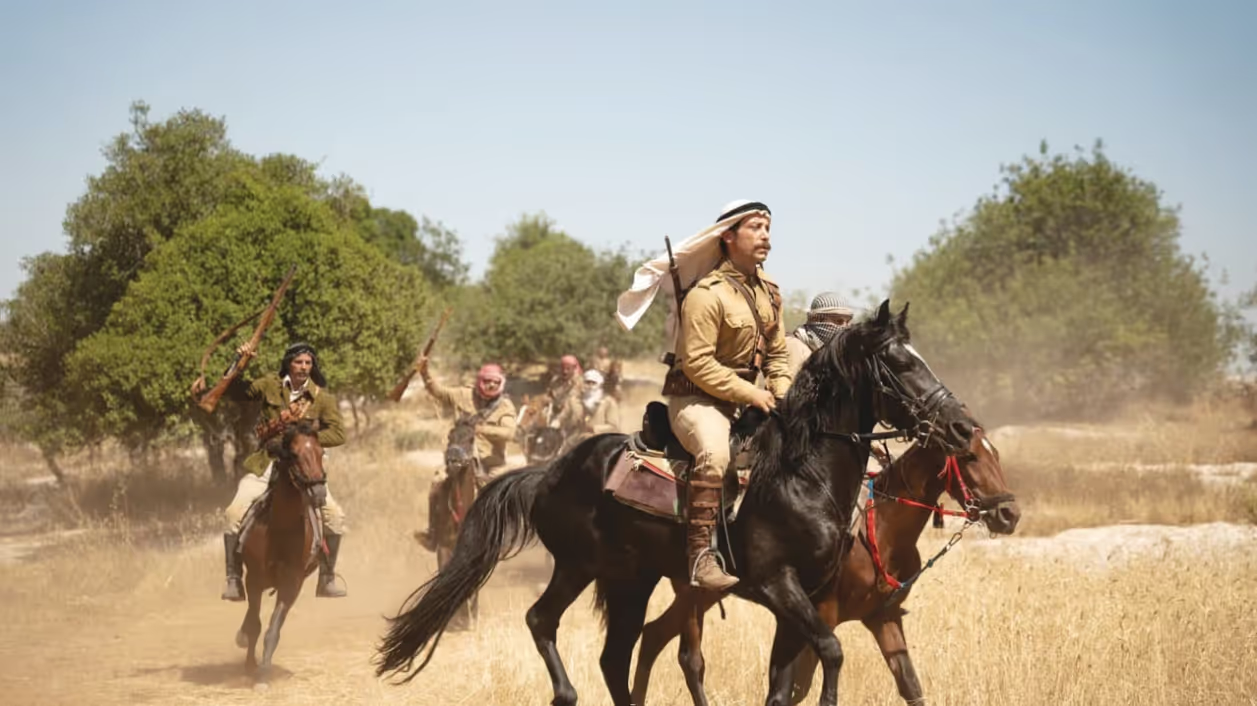
Photo Credit: Palestine 36/Facebook
Will the final marriage of Pallywood and Hollywood become cemented?
The 98th Oscars ceremony of the Academy of Motion Picture Arts and Sciences is not scheduled until March 15, 2026, but the submissions process has begun. “Palestine” has picked Palestine 36 for the Best International Feature category. It is a 118-minute-long historical drama directed by Annemarie Jacir. It “tells the story of the [late 1930s] Palestinian revolt against British colonial rule.
The film’s production companies are multiple. They are from several European countries as well as BBC Film, the Doha Film Institute, the Jordan Film Fund, and others.
Jeremy Irons plays the British high commissioner. The character Yusuf moves from his village to the city and back. He’s a dissatisfied port worker and is drawn into a rebel movement. A female lead is also trying to find her way in life.
Presentations of historical drama are set in a past era and feature events, figures, or settings. Accuracy is blended with fictional elements to create an engaging story. As a subject, Palestine 36 fits that framework quite well. Unfortunately, will an improper balance between fact and the cinematic fictional elements override the genuine historical narrative?
The historicity of Palestine 36
As it is set in 1936, the Arab revolt “against British colonial rule” is at its core. However, Britain was not a colonial ruler in the territory known then as Palestine: It was the Mandatory Power charged with carrying out the League of Nations decision to reconstitute the historic Jewish national home.
Moreover, the Arabs there didn’t quite refer to themselves as “Palestinians.” For example, the revolt’s leadership was the Arab Higher Committee. Palestinians usually referred to Jews. In addition, Jews were not colonialists in their homeland, which Arabs conquered in the 7th century.
British rule was only harsh in the sense that it denied, as much as it did, the Arabs’ goal of eradicating any Jewish sovereign political presence from the land. On May 2, 1936, US consul-general in Jerusalem Leland Burnette Morris wrote to his superiors that there had been “agricultural sabotage as the burning of crops, the despoliation of groves, and the uprooting of trees.”
THE FILM’S protagonist is “caught between his rural home and the political upheaval in Jerusalem, as tensions rise amid growing unrest.” The period of 1936-1939 most certainly was one of unrest. However, there were earlier periods of violence and terror.
Jews were killed and injured in the anti-Zionist Arab violence of April 1920. In May 1921, in Jaffa and five rural settlements, Jews were also killed and wounded. In 1929, some 133 Jews were killed (over 60 in Hebron) and 339 wounded. During this decade, the Arabs rejected two proposals for a Legislative Council with an anti-Zionist majority.
In 1923, an attempt was to establish an Arab Agency to provide the Arab community with “special consideration.” The Arab leaders rejected this offer. In 1931, the Mufti of Jerusalem, Haj Amin al-Husseini, convened an anti-British, anti-Jewish World Islamic Conference and there was organized Arab violence and a strike in 1933.
Will all this political rejectionism, violence, and failure of Arab leadership be in the film? More importantly, will the pre-1936 violence be showcased?
Will that port worker be shown joining the Haifa-based “Black Hand” terror gang founded by Sheikh Izz al-Din al-Qassam in 1930? Doubtful. Their victims included three members of Kibbutz Yagur who were murdered on April 11, 1931. In early 1932, there was an attempted bomb attack on Jewish homes and other attacks that killed and wounded Jews in other communities. On December 22 of that year, they murdered a Jewish father and son in Nahalal.
After killing police constable Moshe Rosenfeld near Ein Harod in 1935, al-Qassam and followers were hunted down. They fled to a cave near the town of Ya’bad, 20 kilometers West of Jenin. Al-Qassam and three of his men were killed there on November 20. Five days later, Arab leaders subsequently demanded Britain halt Jewish immigration, prohibit land sales to Jews, and insisted on exclusive Arab self-rule.
Five months later, on the night of April 15, 1936, three Jews were killed by Arabs on the highway between Tulkarm and Nablus. On the following night, two Arabs were killed near the Jewish town of Petah Tikva (now one of Israel’s five most populous cities).
The Revolt broke out in Jaffa and Tel Aviv on April 19, 1936. According to rumors, some Jews had killed two or three Arabs in Tel Aviv. This news was unfounded, but fourteen Jews and two Arabs were stabbed to death in Jaffa the next day.
THIS, THEN, is the actual backdrop to the outbreak of Arab anti-British and anti-Jewish terror of 1936-39. Over 500 Jews out of 400,000 were eventually murdered during those three years – a ratio almost nine times that of Jews killed on October 7, 2023. British officials were assassinated and police personnel and soldiers were killed in the fighting. Among them was the acting district commissioner of Galilee and his police escort, who were fatally shot by Arab gunmen in Nazareth on September 26, 1937.
More tragically, that Arab terror campaign convinced the British to renege on their Mandate. Instead of the reconstitution of the Jewish national home, the 1939 White Paper declared that it opposed the idea that “Palestine should be converted into a Jewish State against the will of the Arab population of the country.”
Immigration was severely curtailed and land purchases prohibited. Europe’s Jews were sacrificed to Hitler’s plan of extermination. There would be no Jewish national home but ultimately, “an independent Palestine State” should be established.
In the Mandate territory, the Arab terror bands plundered and raped the local Arab population and eliminated their rivals. The pro-government Nashashibi family raised irregular, militia-style “peace bands,” and hundreds of Arabs died in the intra-communal violence, besides all of the Jewish victims.
The Arabs became victims of forced cultural dictates. The keffiyeh was forced on the urban populace, as was the veil (hijab). Is any of this in the script? Will the October 2, 1938, Tiberias Massacre appear where Arabs murdered 19 Jews, 11 of whom were children, stabbing them and burning them? Probably not, based on some of the movie’s sponsors.
If, indeed, this film is to be a historical drama, will any of this real history make it to the screen? Or is this to be an “improved” cinema production, one in which the final marriage of Pallywood and Hollywood becomes cemented?
Article first published in Jerusalem Post, 31 August, 2025
About the writer:
Yisrael Medad is a researcher, analyst, and commentator on political, cultural, and media issues.